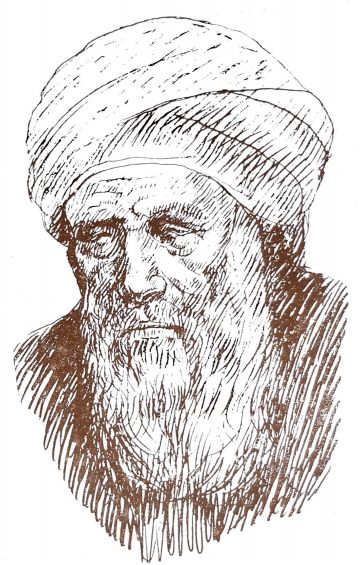
Abu al-Ala al-Ma'arri
Arab poet and philosopher, one of the greatest writers in Arabic, from Ma'arrat al-Nu'man
The blind poet who questioned everything — even the existence of God.
Abu al-Ala Ahmad ibn Abdullah ibn Sulaiman al-Ma'arri was born in 973 CE in Ma'arrat al-Nu'man (north of modern Idlib). He lost his sight at an early age due to smallpox (around age 4), and became a blind poet who produced some of the deepest work in the Arabic language.
He studied in Aleppo, Tripoli, and Antioch, then returned to Ma'arrat al-Nu'man around 1010 CE after the death of his parents. He renounced marriage and meat, and called himself "the prisoner of two prisons" — the two prisons being celibacy and blindness.
His major works:
- Luzum ma la yalzam (The Necessities of What Is Not Necessary) — a long poem (around 4,000 lines) that questions religious and social doctrines, and espouses philosophical pessimism. In one famous couplet: "This in which the world is made..." — it was rejected by some contemporaries as heresy, but is studied today as the greatest Arabic philosophical text of the Middle Ages
- Risalat al-Ghufran (The Epistle of Forgiveness) — a long prose poem (said by some scholars to have later inspired Dante's Divine Comedy), in which al-Ma'arri imagines himself visiting the afterlife
- Al-Sahil wa al-Shahij — a philosophical treatise against the meat industry and animal use
Al-Ma'arri is among the deepest of Arab thinkers, having anticipated his age in declaring philosophical scepticism and animal rights. He lived in Ma'arrat al-Nu'man until his death in 1057 CE.
Ma'arrat al-Nu'man later witnessed one of the worst massacres of the First Crusade in 1098 CE — when the Crusaders stormed the town and slaughtered its people. The town was also a site of fierce battles in the Syrian civil war.